Geometry Kernel for Solid, Surface and Wireframe Modeling
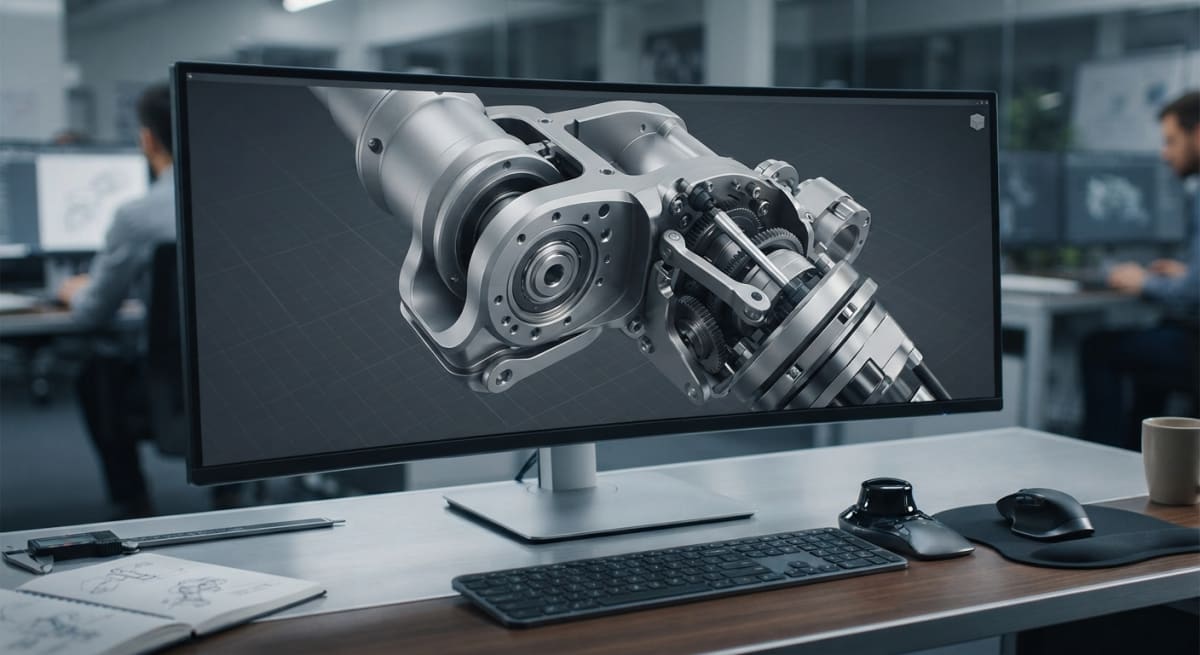
Modern CAD applications depend on reliable geometric technology to create and manipulate digital models. A geometry kernel provides the mathematical and computational foundation for handling shapes such as solids, surfaces, curves, edges, and vertices. It supports the operations that allow engineering software to construct accurate models and perform geometric calculations.
For developers building professional CAD, CAM, CAE, or other 3D applications, the choice of geometric technology can influence accuracy, performance, and the overall flexibility of the application. A capable kernel can provide foundational functionality while allowing development teams to concentrate on user workflows and specialized engineering features.
#What Is a Geometry Kernel?
A geometry kernel is a software component responsible for core geometric operations within a modeling application. It can represent different types of geometric entities and provide methods for creating, editing, analyzing, and combining them.
Instead of implementing complex mathematical algorithms independently, developers can use a kernel as the foundation of their modeling system. This can reduce development effort while providing access to established geometric functionality.
The kernel typically works behind the scenes, while the application's interface provides users with tools for interacting with the resulting models.
#Solid Modeling Capabilities
Solid modeling is essential for many mechanical engineering applications. A solid represents a three-dimensional object with a defined volume and boundary.
A geometry kernel can support operations such as creating primitives, combining bodies, subtracting material, and modifying shapes. These operations allow developers to build applications capable of representing real-world mechanical components.
Accuracy is particularly important when models are later used for manufacturing, simulation, measurement, or other engineering activities. Small geometric inconsistencies can affect downstream processes, making reliable solid modeling an important consideration.
#Surface Modeling
Surface modeling provides another important approach to representing three-dimensional forms. It is particularly useful for products that contain complex shapes, curved exterior surfaces, or designs where the visual form is more important than a simple solid representation.
A capable kernel can support the creation and manipulation of surfaces, including operations involving curves and surface boundaries.
Surface modeling can be useful in industries where designers need to create sophisticated forms while maintaining control over individual geometric elements.
#Wireframe Modeling
Wireframe models represent objects using geometric elements such as points, curves, and edges without necessarily defining complete surfaces or solids.
This modeling approach can be useful for specialized applications, technical layouts, geometry analysis, and certain stages of design development. A geometry kernel that supports wireframe entities gives developers additional flexibility when creating applications for different engineering workflows.
Wireframe information can also serve as a foundation for creating more complex surfaces or solids.
#Handling Complex Geometric Operations
Modern engineering applications often require more than basic shape creation. Developers may need operations for intersections, trimming, offsets, transformations, projections, and other geometric calculations.
Implementing these functions independently can require considerable mathematical expertise and testing. A specialized kernel can provide a foundation for these operations, allowing application developers to focus on how users will apply them.
Complex models should be included in testing because geometric operations may behave differently when working with detailed or tightly connected features.
#Accuracy and Robustness
A geometry kernel should be evaluated not only by the number of functions it provides but also by how reliably those functions handle real engineering data.
Robust geometric calculations can help reduce modeling errors and support consistent downstream workflows. Developers should test the technology using models representative of their target applications.
Validation can include checking geometric results, handling edge cases, and examining behavior when models become increasingly complex.
#Performance and Scalability
Engineering applications may need to process large assemblies or detailed components. Kernel performance can therefore have a direct effect on application responsiveness.
Developers should consider memory usage, processing speed, and the ability to handle complex operations efficiently. Benchmarking with realistic datasets can provide useful information about how the technology will perform under production conditions.
#Choosing a Geometry Foundation
Selecting geometric technology is an important architectural decision for any application that works extensively with 3D models. Developers should consider solid, surface, and wireframe capabilities together with accuracy, robustness, performance, integration, and long-term maintainability.
A well-chosen geometry kernel can provide the foundation for sophisticated modeling applications without requiring development teams to implement every fundamental geometric operation themselves. By building on reliable geometric technology and combining it with effective visualization, data management, and application-specific workflows, developers can create capable 3D engineering software for a wide range of professional uses. Choosing CAD File Format Conversion for Engineering Projects
#C3DModeler #CADKernel
Enjoyed this article?
We're always looking for guest writers. Share your expertise with our community and reach thousands of readers.
Submit a Guest Post →